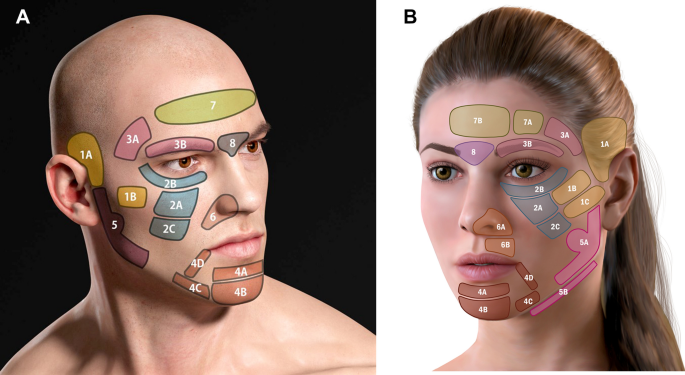
Dermal fillers are primary tools for restoring age-related volume loss in the midface. The nasolabial folds (smile lines) are common treatment areas. However, directly filling the fold can often look unnatural. A sophisticated injector maps facial fat pads and injects strategically.
1. Selecting Hyaluronic Acid Viscoelasticity
High G' (elastic modulus) fillers are required for structural lift and are placed deep on the bone. Low G' fillers are soft and fluid, ideal for superficial dermis injections where natural movement is essential. Selecting the wrong viscosity can lead to lumpy results or early displacement.
2. Midface Lifting: The Lateral Cheek Approach
Instead of injecting directly into the smile fold, injectors should first support the zygomatic arches. Restoring volume laterally pulls the skin upward, naturally smoothing out the nasolabial fold and preserving natural facial expressions.
Frequently Asked Questions
Cheek fillers should be placed deep on the cheekbone (periosteum) using a needle or cannula. This provides a structural anchor that lifts the midface tissues.
High G' fillers have higher elasticity and resist deformation, making them ideal for bone-level lifting. Low G' fillers are soft and spread easily, suitable for superficial wrinkles.
Hyaluronic acid fillers can be dissolved by injecting hyaluronidase, a specialized enzyme that breaks down the cross-linked sugar chains of the filler within hours.
Cheek filling addresses the root cause of the fold—sagging midface tissues. Direct injection into the fold can result in a heavy, flat, or unnatural look.
Vascular occlusion occurs if filler is injected into an artery, blocking blood flow. It is managed by immediate injection of high-dose hyaluronidase, warm compresses, and massage.
They typically last between 6 and 18 months, depending on the thickness of the product used, the injection depth, and the patient's individual metabolic rate.
Want Hands-On Injectables Training?
Enroll in our certified Injectables programs and intensive clinical workshops to practice procedures on live models under doctor supervision.
Explore Courses Book Free Counselling Call