
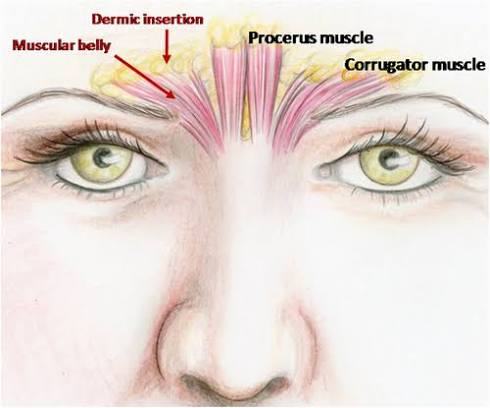
Botulinum Toxin Type A (commonly referred to as Botox) is a highly effective, temporary treatment for reducing dynamic facial wrinkles. For medical injectors, mastering Botox requires a deep knowledge of facial anatomy, reconstitution dynamics, and precise injection depths. Injecting too superficially or too deeply in specific zones can lead to cosmetic mishaps like brow ptosis (drooping eyebrows).
1. The Anatomy of the Frontalis Muscle
The frontalis muscle is the primary muscle responsible for elevating the eyebrows and producing horizontal forehead lines. Unlike other facial muscles, it is broad, thin, and fibers insert directly into the skin of the eyebrows. To treat forehead lines without causing brow ptosis, injectors must stay at least 2 cm above the orbital rim.
2. Dilution and Reconstitution Guidelines
Standard reconstitution practices involve adding preservative-free 0.9% sterile saline to the vacuum-dried toxin vial. Keeping the dilution consistent (typically 2.5 ml of saline per 100-unit vial, yielding 4 units per 0.1 ml) ensures predictable diffusion patterns. High volume dilution increases diffusion range, which can lead to accidental paralysis of adjacent muscle groups.
"Accurate dosing and precise needle angulation prevent Botox from spreading into the levator palpebrae superioris muscle, which is the primary cause of eyelid ptosis."
3. Standard Protocols for Forehead Injections
- Needle Angle: Insert the 30G or 32G needle at a 90-degree angle directly into the muscle belly.
- Depth Control: The frontalis is a superficial muscle. Injections should reach the mid-dermal to intramuscular junction. Avoid placing it sub-periosteally.
- Patient Assessment: Always ask the patient to raise their eyebrows dynamically to mark muscle activity peaks before injecting.
Frequently Asked Questions
Brow ptosis occurs when the frontalis muscle is overly relaxed or injected too close to the eyebrows (less than 2 cm above the orbital rim), causing the forehead to droop.
Botox is reconstituted by gently adding sterile, preservative-free 0.9% saline into the vacuum-pressurized vial. Shaking must be avoided to prevent denaturing the protein.
If ptosis occurs, it is temporary. It typically resolves within 4 to 6 weeks as the neurotoxin's effect wears off, even though full Botox results last 3 to 4 months.
A standard dilution is 2.5 ml of saline per 100-unit vial, resulting in 4 units per 0.1 ml. This concentration limits diffusion and ensures precise placement.
Yes, by performing 'micro-dosing' (injecting smaller, diluted quantities) and keeping the injection points high on the forehead, the patient retains natural eyebrow mobility.
The frontalis is a relatively superficial muscle. The needle should be inserted at a 90-degree angle to a depth of 2mm to 4mm, reaching the intramuscular plane while avoiding the bone.
Want Hands-On Injectables Training?
Enroll in our certified Injectables programs and intensive clinical workshops to practice procedures on live models under doctor supervision.
Explore Courses Book Free Counselling Call